Thursday, August 15, 2019

Banff, Canmore

Rundle Mountains
You know how you imagine things would look and then it turns out completely different when you actually get there. Canmore was one of them. I dismissed it as a no-where lodging town, much like Mariposa for Yosemite. Sitting across Rundle Mountains however, Canmore turned out to be a scenic resort town in its own right.

By the time we got to Golden BC, I was dog-tired; the 400 mile drive  from Seattle to Kamloops the day before, including stops in Vancouver and hiking Nairns Fall trail, took a toll.  Sitting down for lunch in Kicking Horse Chinese restaurant in Golden, I was thinking that we should stay in Golden for the night and then tackle Lake Louise in the morning. It's about the same distance to Lake Louise from Canmore anyway. But I already made reservation for 4 nights for whopping $750 and there was no cancelling it. So we marched on to Lake Louise and then to Canmore.

Lake Louise


Mirror Lake
Things have ways of working out. The sight of Lake Louise perked me up when we got there, and we charged up Agnes Trail to Mirror lake. It was harder hike than I imagined. It was 4 miles from where we parked, but the total elevation gain turned out to be 1000 feet. It was a real hike, in other words. I survived it with some help from my wife: she occasionally pushed me up on the way up and I leaned on her on the way down.  And now we had 2 full days, instead of 1, in Banff proper.

The next day we went into the town of Banff and hiked the trail to Bow Fall, the main tourist attraction in the park. It was only 1km long. After Agnes trail the day before, that was enough. Then we took Sulfer  Mountain Goldola and lounged at the top for an hour soaking in the view and the sun, and recovering from the hard hike the day before.

On day 3 I struck out on my own. After an easy day (yeah, now I'm calling 2km hike and a gondola ride an easy day), I felt I could tackle whatever's left. That's Moraine Lake trail, Johnston Canyon and Tunnel Mountain trail. That's total of 8 miles and it would've been impossible, of course. But that's how well I felt.

Moraine Lake was a bust. The parking was full, so I had to drive back to the overflow lot 6 miles away by the TC freeway. There, the line for the shuttle to the lake was 120 minutes. I turned around and headed to Johnston trail.
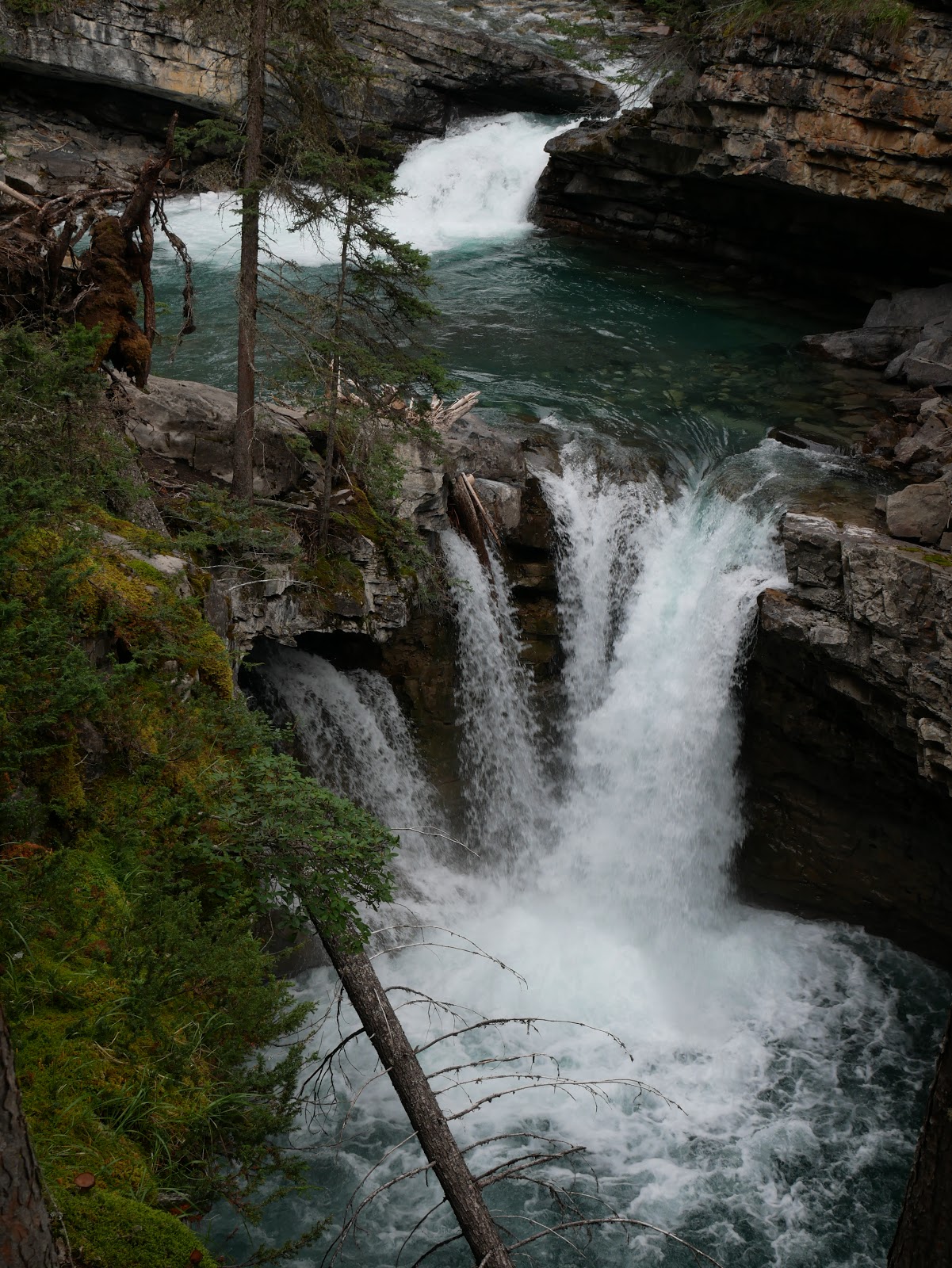
Johnston Creek
Johnston Canyon Trail was total of 4 miles from where I parked on the roadside. And it was about the same difficulty as the Sentinel Dome/Taft Point  hike in Yosemite, except that I did it faster in 3 hours. When finished, my legs were wobbly, but I still felt ambitious enough to go for Tunnel Mountain trail.


But the Tunnel Mountain trail was petty steep. The upper portion was only 1 mile and 800 ft in elevation, shorter and steeper than Agnes trail. The initial 0.1 mile in particular was straight up on stairs and the aftermath of Astoria Tower weighed on me. I gave up.

On the way to Tunnel Mountain trail, however, I came across Surprise Corner, the best vista point in the whole park that I didn't know about. You can climb down to the river from the top and it'll drop you right below Bow Fall. The view is just out of this world.

View from Surprise Corner

So, I hiked almost everyday since we left home. And 4 days in a row in Canada: Nairn Falls for 2 miles, Agnes trail for 4 miles, Bow Falls for 2 km and then Johnston Canyon for 4 miles. This trip has been twice as intense and twice as long so far, as the trip to Oregon last year. And I still was up and running by the time we left Banff. Should I declare that I recovered? Anybody not well versed with CFS would. But I know better. I'll probably will struggle for 3 weeks when I get back home. Then I'll settle into the steady state of 30,000 steps per week. (It would be nice to settle to 45,000 steps like in June, but the summer will be over by the time I'm done with the post-trip struggle). But you can always hope that the Spring is eternal.

Monday, August 12, 2019

Vancouver to Kamloops

What do you look like in the Summer?
A little sunnier in disposition, perhaps.
With the wet clouds gone, the blue glass boxes 
Lining your shoreline and boulevards 
Will shimmer under the sun
And your pale residents
Will come out from your belly 
And clog the trails of Stanley Park 

12 years ago, I wondered what Vancouver would look like in the summer. Now I have an answer. The picture below doesn't show it, but a lot of people were out biking and hiking in Stanley Park. Enough that a cop stopped me to point out that there were so many people on the road and I was driving too fast. Kinda embarrassing, but we had a long way to go and I was in hurry to get out of Vancouver.

Vancouver in Summer


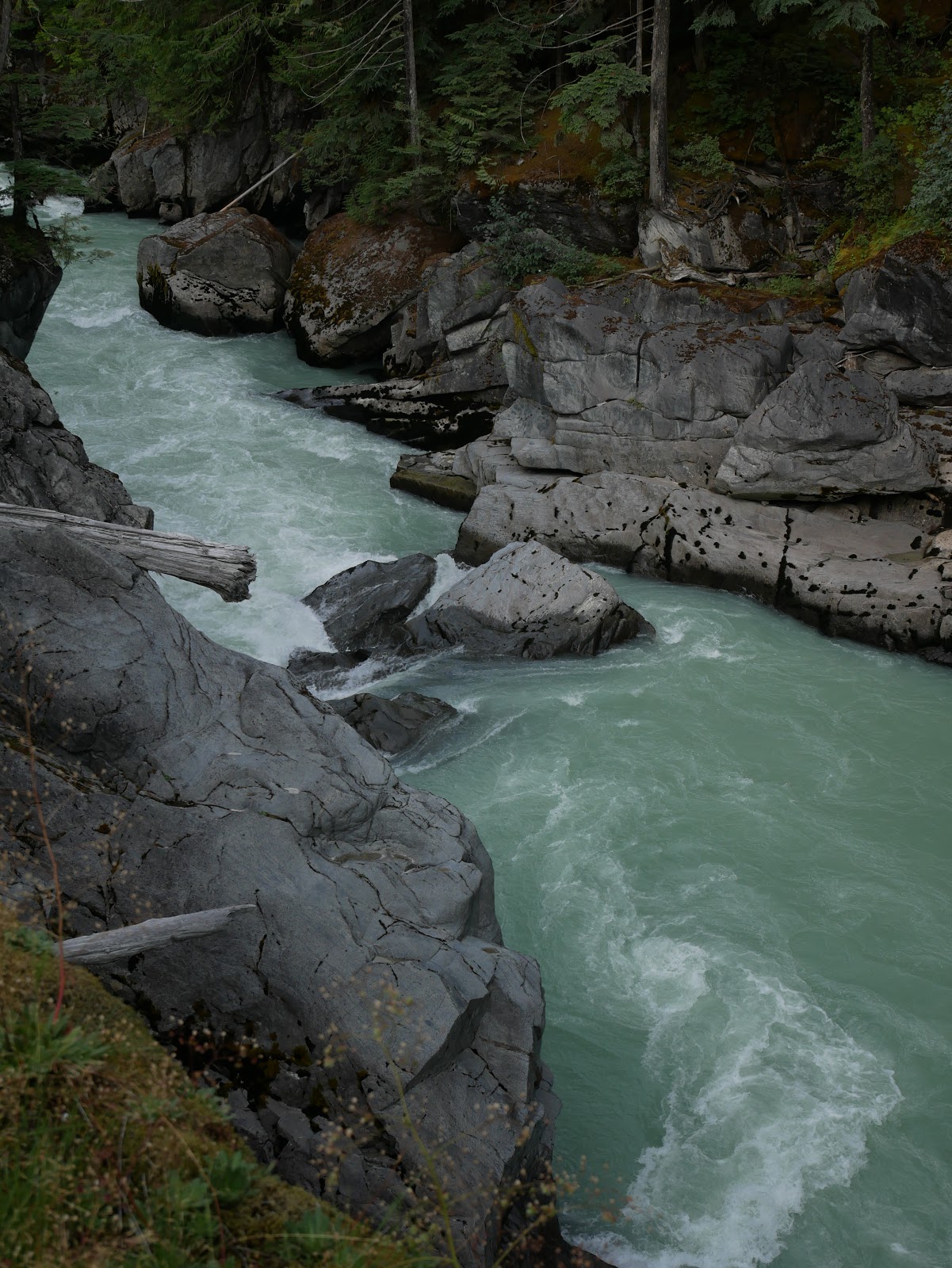
We were skiing in Whistler back then, in the last days of 2007 just before I got sick with CFS. Now I'm here again,  hiking this time. Near Pemburton at the end of sea-to sky highway was a mile long trail to Nairn Falls along bluish grey Seton river. Since I gave up on Stawamus Chief Mountain trail in Squamish -- it was going straight up 1500 feet with lots of stairs -- I had to do this one.

Seton River near Nairns Fall
After Pemberton was the road to Kamloops that deserves a day of touring by itself. The Canadian Route 99 winds through the mountains culminating in Lilooets, a town of river and lakes surrounded by mountain cliffs. We descended on it at night with the moon, almost full, leaking its yellow light on the surrounding clouds. It was surreally beautiful and left me asking "what do you look like in daytime?"  I'm sure I'll be back for it, like I did for Vancouver.

Saturday, August 10, 2019

Seattle


Kalaloch Beach

Climbing up Astoria Column was a big mistake. It's no more than 150 feet tall, nothing compared to 4 miles and 600 feet elevation hike I now am able to. But it was straight up  on spiral staircase. And it is always the sustained intensity that keels me over.  The next day I was  marooned all over again. The charging station at Kalaloch Lodge was about 300 m  away and I couldn't walk back to it after lunch. I had to send my wife to get the car despite she doesn't have a driver's license.

By the time we got to Sol Duc in the afternoon, however, I mostly recovered. In the past, such mistakes  would've costed me several days at the minimum. Now it's mostly one or two day affair. That's how far I progressed. Add the fact that I'm more exercise tolerant while I'm traveling, PEM is cut down to half a day.


Our 4500 mile trip to and from Canadian Rockies thus started.

It was  a smooth sailing till then. We left on Monday for CA coast and got to Eureka for the total of about 400 miles and millions of stops along the way for sightseeing and hiking.  More of the same the next day to Lincoln City, OR.

Somewhere North of Jenner, CA

Trinidad, CA


Cascade Head, OR
The original plan was to spend 2 nights in Lincoln city, so that I could get a full day of rest after hiking Cascade Head. Right after Cascade Head however, we went on to Aberdeen. And a smart decision that was. The Olympic Loop was just too big and it would've been impossible to make it one day from Lincoln City to Port Angeles. Starting the day from Aberdeen instead of Lincoln City allowed us to spend several hours in Sol Duc, hiking the trail to Sol Duc water fall and then dipping in the hot spring. And I tell you, alternating between hot spring and cold pool does wonders for your fatigue and ache after a long day.

Madison Fall in Elhwa Valley


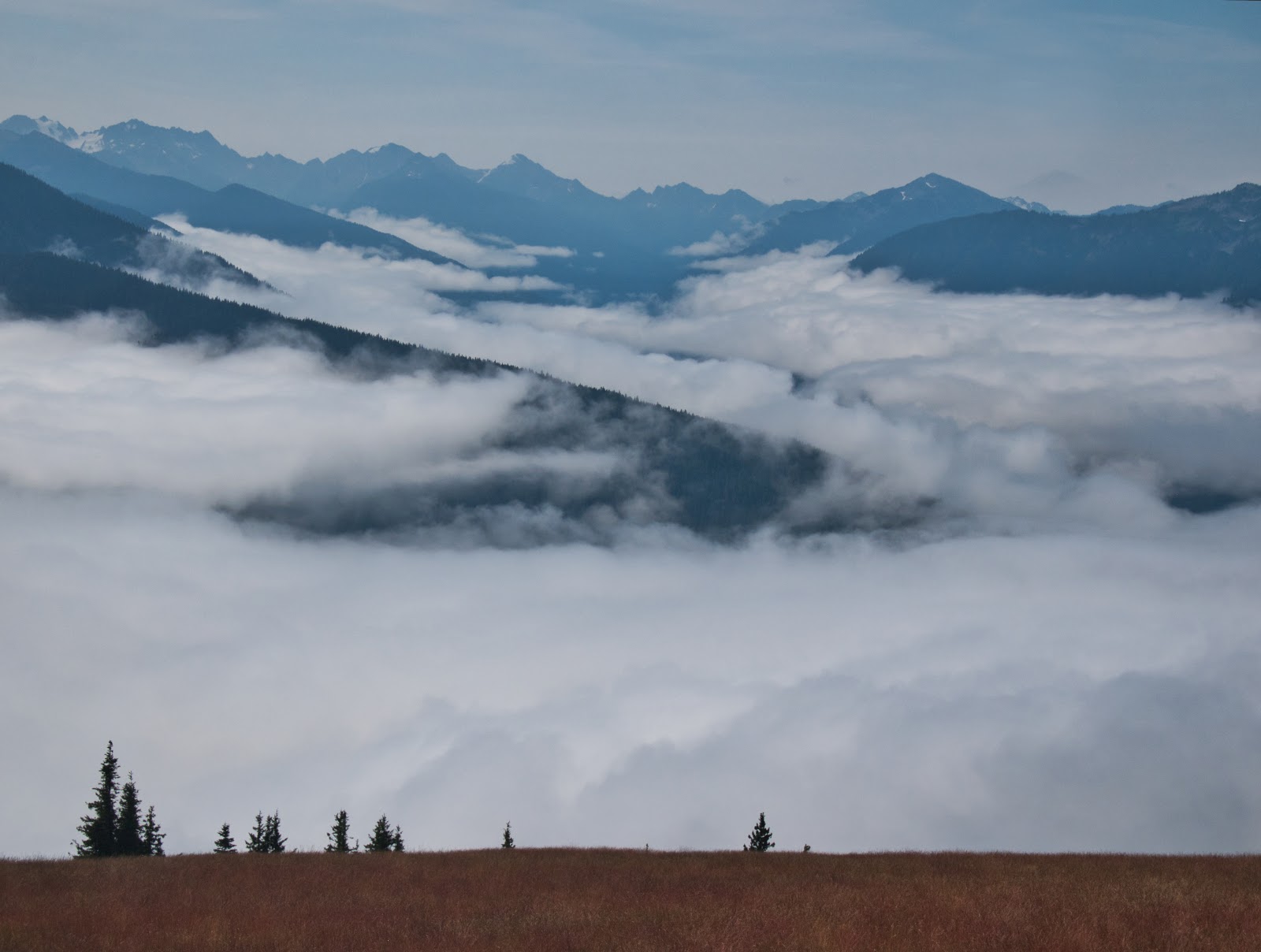
View from Huricane Ridge
Entering Seattle over water via Bainbrige ferry rather than through land was yet another smart decision. For $18, we got to see the spectacular skyline from the water. And save at least one hour of travel time.

Seattle from Bainbridge Ferry


Gas Work Park in Fremont
Now here we are, perched at the Extended Stay in Bothell for 3 days. We stayed at Extended Stay millions of times during our cross-country trip in 2017, it's like coming home. And this is my opportunity to get some well deserved rest after 1,500 miles and charge up before the next leg to Banff.

I was here 12 years ago for the Whistler trip. We flew in and then rented cars to drive up North. We only had one day in Seattle. The dinner at the top of Space Needle was the highlight. (The rotating restaurant was no  longer, so we didn't go up this time.) Then we stopped there again on the way back for the New Years firework. I delegated the Seattle portion of the plan to someone else, so I don't remember the rest too well other than we hung out in the sculputure park and West Seattle.

The best way to explore a city is to divide it into neighborhoods and submerge yourself in them, one at a time. 3 days gave us enough time to do just that and we covered Fremont, Queen Anne, and Capitol Hill as well as Pioneer Square. Now I can say I have a better understanding of the city.

Despite the setback from climbing Astoria Column, I finished the week with 80,000 steps, the most ever. And, yes, the trip ended the PEM struggle after 5 mile hike prematurely by one week. In fact, it was over two days before the trip when I got busy with planning and packing.  Take a look:


Friday, August 2, 2019

Back in 2015

Yep, the 5 mile hike was a big mistake. 4500 steps yesterday, and I'm wallowing in that familiar feverless feverishness today. The gravity, about ten times as strong as it was yesterday, have me pinned down on the couch. I lay on my side -- pressing down on my iliotibial band relieves the thigh ache -- cross my ankles and have my legs stretched. Same thing with my wrists and triceps.

Yesterday was a brief respite: I did 6500 steps on Monday and paid price for 2 days. And now I'm right back in the pit. I am in about the same shape as I was in 2015 before the sudden improvement in June 2016.

Saturday, July 27, 2019

5 Mile Hike And Aftermath

The Sentinel Dome - Taft Point hike in Yosemite was encouraging. I had the usual up and down for 3 days and then was right back up on my feet. No lasting PEM; I continued to register more than 40,000 steps a week. So I figured I should make the hiking a weekly event.

As usual, I got over-ambitious. I went for 5 mile hike last Saturday on Southfork American River Trail. It was the best rated trail near Sacramento on the website. Except that it wasn't. There were some distant views of the river soon after the ascent, but the trail was lined mostly with poison oak and dried up bushes the rest of the way. It was drab. But then, anything would be a drab after Sentinel/Taft.  I started at 11 and finished near 5PM, so it took me almost 6 hours for the effort.


I thought I was going to get away with it when I came out of 3 day recuperation period. But no, not this time. My exercise ability is now so shrunk, I struggle with 5000 steps a day. This week I barely registered 30,000 steps total.  An exertion would keel me over for 30 minutes, and then I'd get paralyzed for two hours, 5 hours after. The post-exercise inflammation wave is now highly pronounced and the constant need to lie down returned.

I'll have to lay low and abide my time for 2 more weeks. Except that I'm going on a 3 week trip through Western US/Canada to Banff National Park next week. It'll be 4,500 mile trip, a mini version of the cross-country trip we did in 2017. I think I'll manage alright. The novelty effect will kick in and I'll be road-worthy once I start out. If not, well, I can always turn around and come back. Just like I was prepared to do when we left for the cross-country trip.


Monday, July 8, 2019

Sentinel Dome and Taft Point

This one was worth 4 miles, and 20,000 steps total for the day. It's the most I've ever done since 2008 and it handily beat 16,000 steps I did in NYC in 2017.


I wasn't ambitious enough to the 5.5 mile loop. I was going to go as far as Roosevelt Point and back, then I realized I could do both Sentinel and Taft for the same distance. All I had to do was come back to the trail head and then head in the other direction. If I didn't feel up to it after Sentinel Dome, I could call it quit and my car would be right there too. I didn't quit. I probably could've done the loop the way I felt at the end of it.


I planned to take a 10 minute rest every 1000 steps. Going up to Sentinel Dome, I did. Then it became 10 minutes every half a mile from Sentinel Dome to Taft Point. Same thing on the way back up from Taft Point. It was getting past 6 PM and I only took only one break for the last 1 mile.


Strange thing's been happening this summer. Whenever I overdo, I have difficulty sleeping. It's similar to the sudden wakefulness that happened back in 2016, except that it is now happening after heavy exercises. It happened about 4 times and it was the same this time: I only slept 6 hours and I was ready to get up this morning. And there was no fatigue of sickness variety; only the exercise fatigue, and some dizziness, that you'd expect if you were healthy. It's as if I am recovered.

Except that I'm not. In between these exercise induced wakefulness, I fall back to the CFS state struggling with 6000 steps and then sleeping like a baby. I could play Jesus and try to walk on the water by keep over-exercising before I fall into the CFS state and wallow. I tried that, and it didn't work. My brain may be awake, but I was constantly in the exercise-recovery mode that I wasn't functioning, neither physically nor mentally. I was more like a zombie. Then, my ability tailed off after 2 long walks in 3 days, making me further useless. So I limited the over-exercise to a day or two a week.

Tomorrow I will poop out and get back to sleepy state, I'm sure. I'll rest one more day, get some work done -- I'm still working on deriving the fatigue measure from Fitbit intraday data so that I can wrap up my project -- and then go for 2 mile walk on Wednesday.


Saturday, May 18, 2019

Why CFS Is Not Psychogenic

CFS was once thought of as a psychogenic disorder. The evidence that it is biological disorder is mounting and nobody is calling that anymore these days. But I thought of it when I read the NYT article on the invisible attack on US diplomats in Cuba and China. It raised a possibility that what the US diplomats experienced was a mass hysteria. The similarity to the Incline Village outbreak and subsequent labeling of CFS as middle aged women's hysteria is rather striking: they are both highly clustered, had no known cause, and they could not be replicated. No wonder people not versed with CFS thought that it was a conditioned response to initial infection or chronic stress.

And here is why CFS is not psychogenic even without any biological evidence to such. Most patients, including myself, come into CFS without knowing what Post-Exertional Malaise is. People suspect that they have CFS when they are constantly tired. But the real CFS patients struggle for months with worsening of symptoms after exertion. Then, after searching for answers for another months,  they are either diagnosed or find out themselves that it is CFS. They initially suffer from PEM without knowing what it is.

But a trained response in hysteria requires knowing and learning. The noise from the upstairs neighbor, for instance, can immediately trigger violent outburst to someone who had to put up with the annoyance for some time. It seems automatic as if you don't have control, when in reality you can retrain yourself and detach the response from the stimuli. CBT is a useful tool for that.

PEM in CFS is not immediate; it is delayed like a clockwork by 24 hours, just as buboes break out 24 hours after contacting plague. (Funny that I tell CFS people to avoid exertion like a plague). And it happens the same even when you don't know anything about it, just as buboes break out whether you know anything about plague or not. Since psychosomatic response requires the learning, PEM can't be psychosomatic. By extention, CFS can't be.

Learning about your PEM, BTW, takes long time and hard work. Many times I expected PEM but it did not happen. Even more times I wasn't expecting and then hit by the bus when 24 hours rolled in. You have to take a meticulous log of what you do every day and then eventually learn to predict  which activities trigger PEM. Even now after 11 years, I can't reliable predict. I only know that faster speed and/or fewer breaks cause PEM in general.