How is it possible that I can walk 2.5 miles (with 3 breaks) and yet two squats send me to the pound? I knew that squats can make me keel over. But I decided to experiment again since I have the improvement under the belt. No luck. I threw in two squats to the daily regimen and I got sick for 3 days.
Enough with the experiment. I now know that there is no discernable improvement in the walking speed or squat. I'll try again when I can walk 5 miles. (Yes, the walking speed increases arithmetically as the distance increases exponentially).
Sunday, September 11, 2016

Friday, September 2, 2016
CFS as Hibernation
Spent 3 days in a bad mood. Apparently cleaning the bathroom the day after walking 2 mi and then walking 2 mi again the day after was too much. The cumulative effect of exertion is still alive and well; it is only less pronounced because my tolerance to exertion went up. I'll have to go back to cleaning the bathroom in lieu of, not in addition to, the (bi-daily) walk.
Now, today's topic. The UCSD researchers announced this week that they discovered anomaly in the metabolomics of CFS patients. Out of 600 or so metabolites they tested, 80% were severely reduced compared to matched controls. From this, they speculated that CFS patients are in a hibernation state like Dauer worms. For some reason, the body is mistakenly putting the patients in a hypometabolic state that only allowed survival and no more, at a great expense to the quality of life.
One issue with this theory is that humans don't hibernate. Dauer worms and bears can slow down their metabolism, lower body temperature and burrow into a hole or cave. For humans, hibernation means death unless fed and taken care of by other humans. That not a viable evolutionary strategy generation after generation. So it can't possibly be an evolutionary adaptation. Perhaps it is an ancient cellular level response (they call it CDR, or cellular danger response) mistakenly activated. But that still does not explain slew of neurological CFS symptoms. Worse yet, you can't explain with the hibernation theory the ability to exert normally only to get sick the next day. (If you are in a dauer state, you should not be able to exert at the first place). So, for now, the metabolic anomaly is more likely than not yet another symptom of CFS rather than the cause of it.
The problem with CFS research that I see is that researchers focus on their specialties and then speculate whatever the anomaly they find as the cause of CFS. Thus, virus people blame EBV, psychiatrists blame depression, endocrinologists blame HPA axis, and geneticists blame genetic expressions. Now we can add to that growing list gut microbiome and metabolomics. It's the proverbial blind men and the elephant. What we need is a creative thinking, as recently done in schizophrenia and alzheimer's, that can put together all these clues and zero in on the real cause, so that we can come up with a real solution. The problem is, with only $5 million dollars out of NIH's gazillion dollar budget allocated to CFS research, it's not going to attract a lot of researchers. Quantity usually leads to quality in research, and we need that quantity to solve this problem.
As far as I am concerned, CFS is still a neuromuscular disorder, mediated by the immune system.
I think the term Myalgic Encephalomyelitis will ultimately proven right, except that it is the inflammation sensitivity, not the inflammation itself. And the paper's finding that the metabolic response was the opposite to the response to infection or inflammation only proves that there is no infection or actual inflammation in CFS.
Now, today's topic. The UCSD researchers announced this week that they discovered anomaly in the metabolomics of CFS patients. Out of 600 or so metabolites they tested, 80% were severely reduced compared to matched controls. From this, they speculated that CFS patients are in a hibernation state like Dauer worms. For some reason, the body is mistakenly putting the patients in a hypometabolic state that only allowed survival and no more, at a great expense to the quality of life.
One issue with this theory is that humans don't hibernate. Dauer worms and bears can slow down their metabolism, lower body temperature and burrow into a hole or cave. For humans, hibernation means death unless fed and taken care of by other humans. That not a viable evolutionary strategy generation after generation. So it can't possibly be an evolutionary adaptation. Perhaps it is an ancient cellular level response (they call it CDR, or cellular danger response) mistakenly activated. But that still does not explain slew of neurological CFS symptoms. Worse yet, you can't explain with the hibernation theory the ability to exert normally only to get sick the next day. (If you are in a dauer state, you should not be able to exert at the first place). So, for now, the metabolic anomaly is more likely than not yet another symptom of CFS rather than the cause of it.
The problem with CFS research that I see is that researchers focus on their specialties and then speculate whatever the anomaly they find as the cause of CFS. Thus, virus people blame EBV, psychiatrists blame depression, endocrinologists blame HPA axis, and geneticists blame genetic expressions. Now we can add to that growing list gut microbiome and metabolomics. It's the proverbial blind men and the elephant. What we need is a creative thinking, as recently done in schizophrenia and alzheimer's, that can put together all these clues and zero in on the real cause, so that we can come up with a real solution. The problem is, with only $5 million dollars out of NIH's gazillion dollar budget allocated to CFS research, it's not going to attract a lot of researchers. Quantity usually leads to quality in research, and we need that quantity to solve this problem.
As far as I am concerned, CFS is still a neuromuscular disorder, mediated by the immune system.
I think the term Myalgic Encephalomyelitis will ultimately proven right, except that it is the inflammation sensitivity, not the inflammation itself. And the paper's finding that the metabolic response was the opposite to the response to infection or inflammation only proves that there is no infection or actual inflammation in CFS.
Wednesday, August 31, 2016
Improvement, Graphed
I talked about my recent sudden improvement. Here is the graph of weekly number of steps, taken with Fitbit and graphed with R. The second one is zoomed version from June to August.


It shows almost two fold increase in late June. Then, in early July, it dips. That is the week that I walked faster to see if speed also improved. Obviously it did not. It jumps back after the recovery from it. The improvement then fades in the 3rd week of July and the amount of activities steadily declines. This period includes the post-exertional sickness of 4 days after walking 3 miles on 7/23. It then comes back up after the 2nd week of August.
More important than the increased activity is the number of times I got sick. This is how it used to look and how it looks now:

Basically, I've gotten sick only once since June 13. That is an incredible change given that I used to get sick at least once a week as shown in red in the daily log on the left. The improvement not only brought ability to walk more, it also raised the tolerance to exertion, that I'm no longer hitting the ceiling, as long as I keep my walking speed in check.
To sum it up, the distance has increased almost twofold in June for some reason. But I still can't walk more than 2.5 miles, even at a slow speed with 3 breaks, and there is no discernible improvement in the walking speed.


More important than the increased activity is the number of times I got sick. This is how it used to look and how it looks now:

Basically, I've gotten sick only once since June 13. That is an incredible change given that I used to get sick at least once a week as shown in red in the daily log on the left. The improvement not only brought ability to walk more, it also raised the tolerance to exertion, that I'm no longer hitting the ceiling, as long as I keep my walking speed in check.
To sum it up, the distance has increased almost twofold in June for some reason. But I still can't walk more than 2.5 miles, even at a slow speed with 3 breaks, and there is no discernible improvement in the walking speed.
Tuesday, August 30, 2016
Sympathetic and Parasympathetic Fatigue
Since I got Polar H7, I decided to look into the heart rate variability (HRV) and see if it has any correlation to fatigue. I only got 2 weeks worth of data so far, so I can't write it up yet. I'll do that when I have at least 1 month's worth of data. But the topic of sympathetic and anti-sympathetic fatigue popped in the process of looking into it. Various exercise training sites and HRV apps claim that low HRV correlates to stress/deconditioning while the high value corresponds to exercise-induced fatigue.
According to this theory, the stress/deconditioning fatigue requires active recovery (exercise) while exercise-induced fatigue requires rest to recover from it. Sympathetic nerve dominates during the former and HRV plummets. Conversely, Parasympathetic nerve takes over during the latter and HRV goes up. When I came across an article about sympathetic vs parasympathetic overtraining syndrome years ago while researching OTS, I didn't quite understand it. Now they all fit together, at least in theory.
Healthy individuals experience fatigue when deconditioned or mentally stressed. This fatigue is alleviated by exercise. The body goes into parasympathetic dominated mode while trying to recover from exercise and the CNS balance is restored with the rest:
CFS patients, on the other hand, don't get such relief. They are perennially in sympathetic fatigue state and they cannot exercise enough to produce exercise-induced fatigue because they reach the post-exertional sickness threshold of CFS well before they can reach the exercise threshold. Therefore the exercise triggers post-exertional sickness instead, making the CFS fatigue worse:
Competitive athletes reaches their exercise limit first. If they continue to push without adequate recovery, however, they can reach the over-training threshold and end up with OTS fatigue:
Notice the similarity of this curve to the CFS fatigue curve. The difference is that, in case of OTS, the over-training threshold is above the exercise limit while the post-exertional sickness threshold for CFS is below the exercise limit. Post-exertional sickness can be viewed as the overtraining syndrome for CFS patients in this sense, except that it gets triggered much easier because its threshold is well below the exercise limit.
Until recently, my fatigue followed the CFS fatigue curve. I'd keel over whenever I walk more than 2km or walk just a little bit faster. But that has changed for some reason since July. Now I can walk 2 miles without getting sick. The morning after the walk, I am getting the post-exercise fatigue that I recover from rather than plunging into post-exertional sickness. The graph now looks like this:
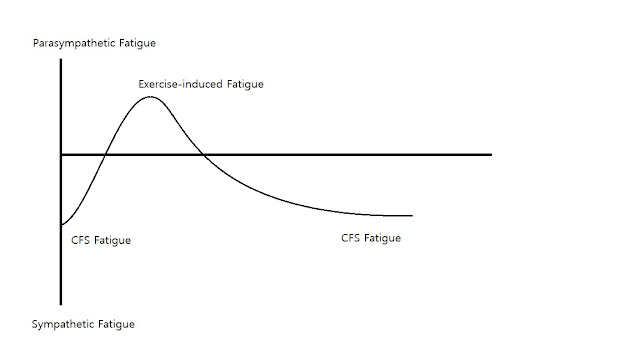 These fatigue curves are all theory of course, and I haven't seen any data to prove it. I'll write up some more when I have enough HRV data. Even if my data confirms, it is a trial with only one patient for 30 or so observations. And obviously no randomization or blinding either. In other words, it still is no more than an anecdote. But it seems like a nice model to visualize CFS vs normal fatigue, regardless.
According to this theory, the stress/deconditioning fatigue requires active recovery (exercise) while exercise-induced fatigue requires rest to recover from it. Sympathetic nerve dominates during the former and HRV plummets. Conversely, Parasympathetic nerve takes over during the latter and HRV goes up. When I came across an article about sympathetic vs parasympathetic overtraining syndrome years ago while researching OTS, I didn't quite understand it. Now they all fit together, at least in theory.
Healthy individuals experience fatigue when deconditioned or mentally stressed. This fatigue is alleviated by exercise. The body goes into parasympathetic dominated mode while trying to recover from exercise and the CNS balance is restored with the rest:
 |
| 1 - Normal Fatigue Curve |
CFS patients, on the other hand, don't get such relief. They are perennially in sympathetic fatigue state and they cannot exercise enough to produce exercise-induced fatigue because they reach the post-exertional sickness threshold of CFS well before they can reach the exercise threshold. Therefore the exercise triggers post-exertional sickness instead, making the CFS fatigue worse:
 |
| 2 - CFS Fatigue Curve |
Competitive athletes reaches their exercise limit first. If they continue to push without adequate recovery, however, they can reach the over-training threshold and end up with OTS fatigue:
 |
| 3- OTS Fatigue Curve |
Notice the similarity of this curve to the CFS fatigue curve. The difference is that, in case of OTS, the over-training threshold is above the exercise limit while the post-exertional sickness threshold for CFS is below the exercise limit. Post-exertional sickness can be viewed as the overtraining syndrome for CFS patients in this sense, except that it gets triggered much easier because its threshold is well below the exercise limit.
Until recently, my fatigue followed the CFS fatigue curve. I'd keel over whenever I walk more than 2km or walk just a little bit faster. But that has changed for some reason since July. Now I can walk 2 miles without getting sick. The morning after the walk, I am getting the post-exercise fatigue that I recover from rather than plunging into post-exertional sickness. The graph now looks like this:

Friday, August 12, 2016
Mystery of Post-Exertional Sickness
Something definitely has changed since July: I'm no longer sleeping well. I walked 2.4 miles yesterday and ended up with less than 5 hours of sleep. I'm now actually sleeping worse on the days that I walked. Are my days of sleeping like baby coming to an end? Sleeping well with even minimal exercise was the only silver lining in these 8 years of sickness.
I should decrease the distance and see if I can sleep well again. It seems paradoxical that I should sleep worse when I walk more. But I used to have the same problem when I was healthy -- I had to occasionally take sleeping pills on days I practiced judo. (The practice time didn't matter whether it was in the evening or afternoon). And maybe I'm having the same problem now. Anyway, the whole purpose of walking for me is to sleep and feel better, so it's no good if walking makes feel worse. If decreasing the distance restores the sleep, then that's the way it will be.
Now, to today's topic of post-exertional sickness. MS fatigue doesn't have it. The cancer fatigue doesn't have it. Only CFS fatigue has it. The post-exertional sickness is the unique symptom of CFS that distinguishes it from all other fatigue. Hence, any self-respecting CFS theory must at least explain the post-exertional sickness.
I used to suspect Delayed Onset of Muscular Soreness (DOMS) as the source of post-exertional sickness. DOMS accompanies inflammation and is delayed by the 24 to 48 hours and lasts 3 to 5 days. That fits post-exertional sickness perfectly. And the fact that the walking speed or a few squats can precisely trigger the post-exertional sickness seems to jibe with DOMS as the source. But there was a paper that did the biopsy of muscle of CFS patients after exercise and did not find micro-tear of the muscle. (I can't locate that paper at the moment, Googling does not turn it up for some reason). Also, inflammation from DOMS are supposed to be local only to the damaged muscle. Though it's still possible that the micro-tear is so minute or few that the investigator simply missed them, and the local inflammation still could affect the central nerve through signaling, it seems reasonable to conclude that DOMS is not likely the source of the post-exertional sickness, at least until there is an evidence for it.
The Journal of Strength and Conditioning Research recently published an article on exercise intensity and recovery. This article must be purchased for you to read, but you can read the summary here. Basically they found:
I should decrease the distance and see if I can sleep well again. It seems paradoxical that I should sleep worse when I walk more. But I used to have the same problem when I was healthy -- I had to occasionally take sleeping pills on days I practiced judo. (The practice time didn't matter whether it was in the evening or afternoon). And maybe I'm having the same problem now. Anyway, the whole purpose of walking for me is to sleep and feel better, so it's no good if walking makes feel worse. If decreasing the distance restores the sleep, then that's the way it will be.
Now, to today's topic of post-exertional sickness. MS fatigue doesn't have it. The cancer fatigue doesn't have it. Only CFS fatigue has it. The post-exertional sickness is the unique symptom of CFS that distinguishes it from all other fatigue. Hence, any self-respecting CFS theory must at least explain the post-exertional sickness.
I used to suspect Delayed Onset of Muscular Soreness (DOMS) as the source of post-exertional sickness. DOMS accompanies inflammation and is delayed by the 24 to 48 hours and lasts 3 to 5 days. That fits post-exertional sickness perfectly. And the fact that the walking speed or a few squats can precisely trigger the post-exertional sickness seems to jibe with DOMS as the source. But there was a paper that did the biopsy of muscle of CFS patients after exercise and did not find micro-tear of the muscle. (I can't locate that paper at the moment, Googling does not turn it up for some reason). Also, inflammation from DOMS are supposed to be local only to the damaged muscle. Though it's still possible that the micro-tear is so minute or few that the investigator simply missed them, and the local inflammation still could affect the central nerve through signaling, it seems reasonable to conclude that DOMS is not likely the source of the post-exertional sickness, at least until there is an evidence for it.
The Journal of Strength and Conditioning Research recently published an article on exercise intensity and recovery. This article must be purchased for you to read, but you can read the summary here. Basically they found:
- Muscle strength is reduced shortly after the exercise and the reduction lasts 12-24 hours.
- The muscle damage marker is present for up to 48 hours.
- Neutrophil, the debris removing immune cells, appear 3 hours after and lasts up to 24 hours
- Lymphocytes, another immune cells, appear 12 hours after and last 3 days
The lymphocyte response accompany inflammation. And the post-exertional sickness could be the sickness behavior caused by this inflammation. A recent paper from Norway that claims that knocking out B-cell lymphocytes with Rituximab brought improvements to CFS patients lends some credibility to the lymphocytes as the source as the post-exertional sickness. Lymphocytes are implicated in chronic inflammation as well.
Tuesday, August 9, 2016
Mono And Judo
If flu shots can cause problem for CFS patients while other vaccines don't, it's not difficult to imagine certain virus infection is more likely than others to trigger CFS. And it appears that more people end up with CFS after a bout with mono infection than other viral infections. The virus goes away in a month or so, but the debilitating fatigue, ache and weakness remains. Maybe it is the long lasting acute inflammation of mono that does it.
People with allergy suffer from long term inflammation too. And there have been enough studies that concluded allergies as a risk factor for CFS. But allergic inflammation is not as acute as viral infection so it is unlikely to result in CFS by itself. But it's possible that allergic people react with more inflammation to viral infection, so maybe they are more likely to develop CFS when subjected to CFS trigger.
Some people also develop CFS after overtraining. It is a well known fact that exercises cause acute inflammation. Extreme exercises in particular can spike the inflammatory IL-6 cytokine up to 100 times during the acute response phase. Then there is inflammation caused by muscle fiber damage resulting in delayed onset of muscular soreness that last 3 to 5 days. Repeated training without giving body time to recover from this inflammation can result in chronic high level inflammation. This prolonged inflammation could be the trigger for CFS in some people. Dean Anderson, for instance, was a competitive cross country skier. And Anna Hemmings, an olympic rower, was once diagnosed for an overtraining syndrome. When she failed to recover after 6 months, the diagnosis became CFS. And that is how I ended up with CFS after training in judo 4 nights a week. There are plenty more cases of competitive athletes developing CFS.
So, this prolonged inflammation appears to be the common denomination for all CFS cases.
People with allergy suffer from long term inflammation too. And there have been enough studies that concluded allergies as a risk factor for CFS. But allergic inflammation is not as acute as viral infection so it is unlikely to result in CFS by itself. But it's possible that allergic people react with more inflammation to viral infection, so maybe they are more likely to develop CFS when subjected to CFS trigger.
Some people also develop CFS after overtraining. It is a well known fact that exercises cause acute inflammation. Extreme exercises in particular can spike the inflammatory IL-6 cytokine up to 100 times during the acute response phase. Then there is inflammation caused by muscle fiber damage resulting in delayed onset of muscular soreness that last 3 to 5 days. Repeated training without giving body time to recover from this inflammation can result in chronic high level inflammation. This prolonged inflammation could be the trigger for CFS in some people. Dean Anderson, for instance, was a competitive cross country skier. And Anna Hemmings, an olympic rower, was once diagnosed for an overtraining syndrome. When she failed to recover after 6 months, the diagnosis became CFS. And that is how I ended up with CFS after training in judo 4 nights a week. There are plenty more cases of competitive athletes developing CFS.
So, this prolonged inflammation appears to be the common denomination for all CFS cases.
Monday, August 1, 2016
CFS and Flu Vaccine
Last November, I struggled more than usual for about 2 weeks. I chalked it up to seasonal change since I saw no apparent reason for that. Reviewing my log later, however, I realized I got a flu shot the day before it started. I logged it as a hospital visit rather than flu shot, so it didn't particularly stood out. I was also getting HepB vaccines around that time, and I didn't notice any problem with vaccines. So I had no particular reason to suspect vaccination either.

The above graph is the plot of the fatigue level predicted by 4 day accumulation of exertion and the actual fatigue. From 11/11 to 11/25, it shows that the actual fatigue was substantially larger than it should have been.
So, I did some googling and found a paper that says flu vaccine causes low grade inflammation, and another paper that suggests low grade inflammation can cause central fatigue. Taken together, the flu vaccine causing problem for inflammation-sensitive CFS patients is not implausible. And, if that is the case, it is not implausible either that lowering ambient inflammation, by diet change, supplement or meditation, can improve fatigue in CFS patients.

The above graph is the plot of the fatigue level predicted by 4 day accumulation of exertion and the actual fatigue. From 11/11 to 11/25, it shows that the actual fatigue was substantially larger than it should have been.
So, I did some googling and found a paper that says flu vaccine causes low grade inflammation, and another paper that suggests low grade inflammation can cause central fatigue. Taken together, the flu vaccine causing problem for inflammation-sensitive CFS patients is not implausible. And, if that is the case, it is not implausible either that lowering ambient inflammation, by diet change, supplement or meditation, can improve fatigue in CFS patients.
Subscribe to:
Posts (Atom)